

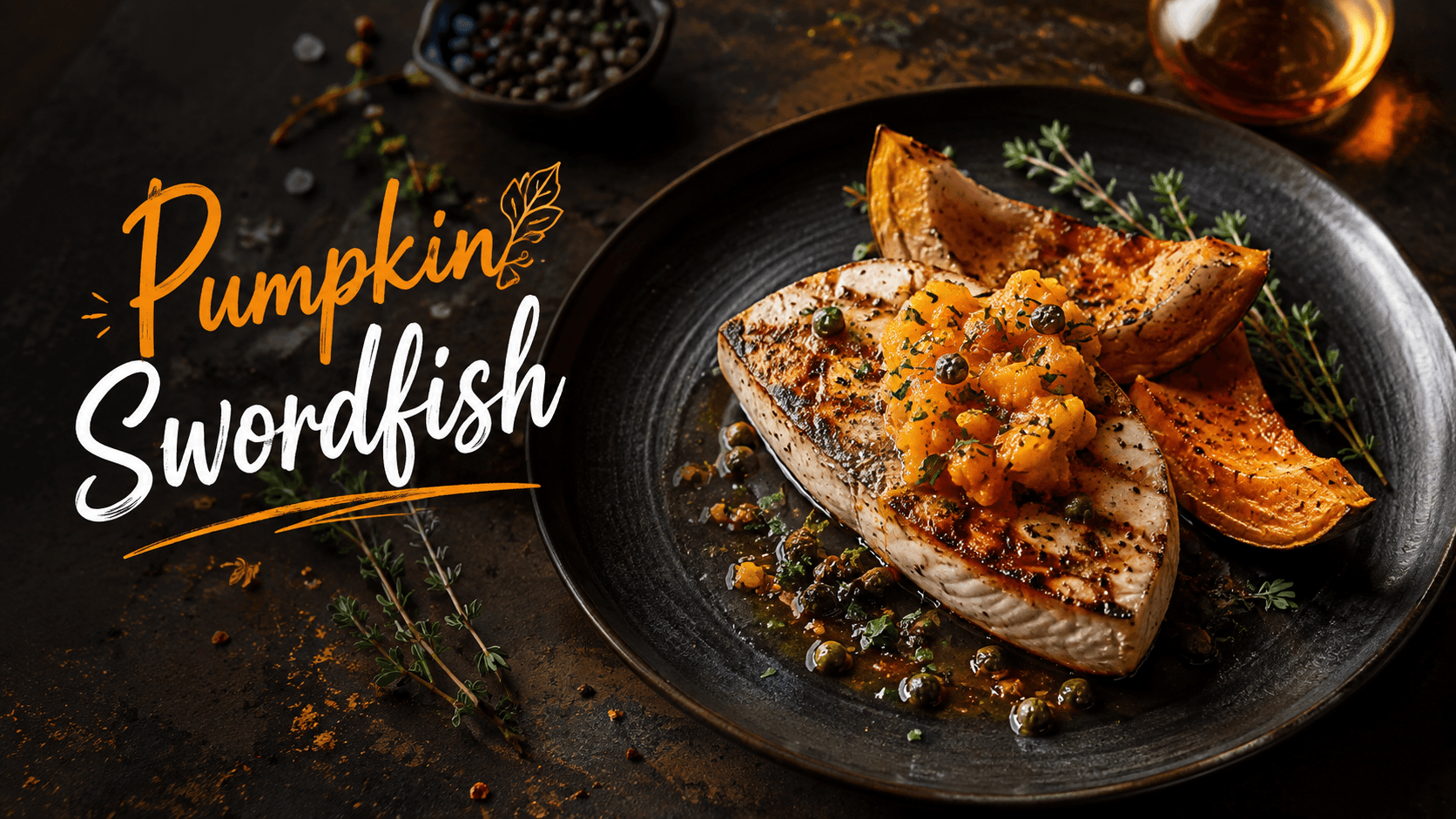
If you’ve spotted “pumpkin swordfish” on a menu or at a fish counter, your first reaction was probably some version of wait, what? Is it flavored with pumpkin? Dyed for a fall promotion? Neither. Pumpkin swordfish is completely natural, ordinary swordfish — it just happens to have deep orange flesh instead of the usual pale white or ivory color, and there’s a straightforward biological reason for that.
Here’s everything worth knowing before you buy it, cook it, or just satisfy your curiosity.
What Is Pumpkin Swordfish, Exactly?
Pumpkin swordfish is a naturally occurring color variation of regular swordfish (Xiphias gladius), the same large, sword-billed fish found in warm and temperate oceans worldwide. It isn’t a separate species, a farmed hybrid, or a marketing invention. It’s the identical fish, same bone structure, same fillet shape — the only difference is what color the meat turns out to be once it’s cut open.
Fishmongers and chefs started calling it “pumpkin” simply because the color resembles the flesh of a pumpkin: a warm, orange-tinted hue that ranges from a light peachy shade to a much deeper, almost salmon-like tone. Some vendors also market it as “orange swordfish” for the same reason.
Because the coloring can’t be seen from the outside, nobody — including the fishermen who caught it — knows a swordfish is a pumpkin swordfish until it’s filleted.
Why Does Some Swordfish Turn Orange?
The color comes down to diet. Swordfish are opportunistic predators that eat a wide range of prey, but some individuals feed heavily on shrimp, krill, and other small crustaceans. These prey animals contain pigments called carotenoids, and one carotenoid in particular — astaxanthin — is responsible for the reddish-orange color seen in a lot of ocean life.
You’ve likely seen this same pigment effect elsewhere without realizing it. Wild salmon get their pink-orange color from eating krill and small crustaceans. Flamingos turn pink because of the shrimp-like organisms in their diet.
Swordfish work the same way: when a fish’s diet is unusually rich in crustaceans over a long period, the carotenoids build up in its fat and muscle tissue, and the flesh gradually shifts toward orange.
Not every swordfish eats this way consistently enough for the color to show. That’s why pumpkin swordfish is the exception rather than the rule, even though the biological mechanism behind it is common and well understood.
How Rare Is Pumpkin Swordfish?
Pumpkin swordfish shows up unpredictably. It isn’t tied to a particular season, region, or time of year — a boat could bring in dozens of swordfish and find that just one or two have the orange coloring once they’re cut open.
Estimates from fishmongers who deal in swordfish regularly suggest it happens in only a small fraction of the total catch, which is part of why it’s treated as a specialty item rather than something you’ll find stocked reliably at a regular grocery store.
Because supply is inconsistent, pricing tends to run higher than standard swordfish, and availability depends heavily on what a particular boat happens to bring in on a given day.
Pumpkin Swordfish vs. Regular Swordfish
| Pumpkin Swordfish | Regular Swordfish | |
| Species | Same species (Xiphias gladius) | Same species (Xiphias gladius) |
| Raw flesh color | Orange to peachy-orange | White to ivory or pale pink |
| Cause of color | High-crustacean diet (carotenoids) | Typical mixed diet |
| Availability | Rare, unpredictable | Widely available |
| Price | Usually higher | Standard market price |
| Cooked color | Turns pale beige, like regular swordfish | Turns pale beige |
| Flavor | Slightly richer, some say sweeter | Firm, mild, meaty |
Does Pumpkin Swordfish Taste Different?
This is where opinions vary a bit, and it’s worth being honest about that. Many people who’ve tried both describe pumpkin swordfish as having a marginally richer or sweeter flavor than standard swordfish, sometimes attributed to a slightly higher fat content from its crustacean-heavy diet. Others say the difference is subtle enough that it’s hard to detect once the fish is cooked and seasoned.
What isn’t in dispute: it does not taste like actual pumpkin, squash, or anything vegetal. The name refers purely to color. Once cooked, pumpkin swordfish loses its orange tint and turns the same pale, opaque color as any other cooked swordfish steak.
If you’re expecting a dramatically different eating experience, temper that expectation. If you’re expecting a genuinely delicious piece of swordfish with maybe a touch more richness, that’s a fair bet.
Is Pumpkin Swordfish Safe and Sustainable to Eat?
The color has no bearing on safety — it’s purely a diet-driven pigment change, not a sign of contamination, spoilage, or illness. That said, a few general swordfish facts are worth knowing regardless of color:
- Mercury:Swordfish is a large, long-lived predator, and like other big ocean predators such as shark, marlin, and king mackerel, it accumulates more mercury than smaller fish. The FDA and EPA advise pregnant women, those who may become pregnant, and young children to avoid it entirely, while other adults are generally advised to limit swordfish to about one serving a week.
- Sustainability:Swordfish sustainability varies by where and how it’s caught. Seafood Watch, the widely used sustainability rating program, rates Atlantic and Pacific swordfish caught with methods like handlines and pole-and-line gear favorably, while swordfish caught with certain longline or gillnet methods in less-regulated fisheries score lower due to bycatch and habitat concerns. Checking the origin and catch method — something a good fishmonger should be able to tell you — is the simplest way to make an informed choice.
None of this is specific to pumpkin swordfish; it applies to swordfish in general, and it’s useful context for anyone buying it for the first time.
Where to Buy Pumpkin Swordfish
Because it’s uncommon and can’t be identified before the fish is cut, you generally can’t search for it by name and expect a guaranteed match. A few practical approaches:
- Ask a local fishmonger.Independent seafood counters that receive whole or partially processed swordfish are far more likely to encounter pumpkin swordfish than a chain grocery store, since they cut the fish in-house.
- Look for direct-from-boat or community-supported fishery programs.Smaller-scale, direct seafood suppliers often deal with individual catches rather than pre-sorted commercial shipments, increasing the odds of spotting an orange-fleshed fillet.
- Ask restaurants that specialize in seafood.Chefs who work closely with local suppliers sometimes get first pick of unusual catches, including pumpkin swordfish, and may feature it as a seasonal special.
If you can’t find it, regular swordfish is a perfectly good substitute in any recipe — the cooking method and result are nearly identical.
How to Cook Pumpkin Swordfish
Swordfish’s dense, meaty texture holds up well to high heat, and pumpkin swordfish is no exception. A few reliable approaches:
- Grilling:A hot grill for four to six minutes per side (depending on thickness) gives good char without drying out the fish. Brush with oil first so it doesn’t stick.
- Pan-searing:A hot skillet with a little oil produces a good crust in about four to five minutes per side for a one-inch steak. Let the fish rest briefly before serving so the juices redistribute.
- Simple seasoning works best.Swordfish’s flavor doesn’t need much help — salt, pepper, a squeeze of lemon, and a pat of butter is often all it takes. If you want to dress it up, a lemon butter sauce or a light hollandaise sauce pairs well without overwhelming the fish.
- Don’t overcook it.Swordfish turns dry and tough past the point of being fully cooked through. Aim for the center to be just opaque, with a slight give when pressed.
Because the color disappears with cooking, there’s no special technique required just because you’re working with the pumpkin variety — the same rules that apply to any good swordfish steak apply here.
Frequently Asked Questions
Is pumpkin swordfish a different species of fish?
No, It’s the same species as regular swordfish. The only difference is the orange color of the raw flesh, caused by diet.
Does pumpkin swordfish taste like pumpkin?
No, The name refers only to its color, not its flavor. It tastes like swordfish, with some describing a slightly richer or sweeter note.
Why is pumpkin swordfish more expensive?
It’s rare and can’t be identified before the fish is cut, so supply is inconsistent. That scarcity tends to push the price above standard swordfish.
Does the orange color stay after cooking?
No, Cooked pumpkin swordfish turns the same pale, opaque color as regular cooked swordfish.
Is pumpkin swordfish healthier than regular swordfish?
Nutritionally, it’s essentially the same fish, so the same general guidance on mercury and serving frequency applies to both.
The Bottom Line
Pumpkin swordfish is a fun example of how much a fish’s diet can shape what ends up on your plate — no dye, no flavoring, no gimmick, just carotenoids from a shrimp– and krill-heavy diet turning ordinary swordfish flesh a striking orange.
If you happen to come across it at a fish counter or on a menu, it’s worth trying at least once, cooked simply enough to let its natural flavor come through.