
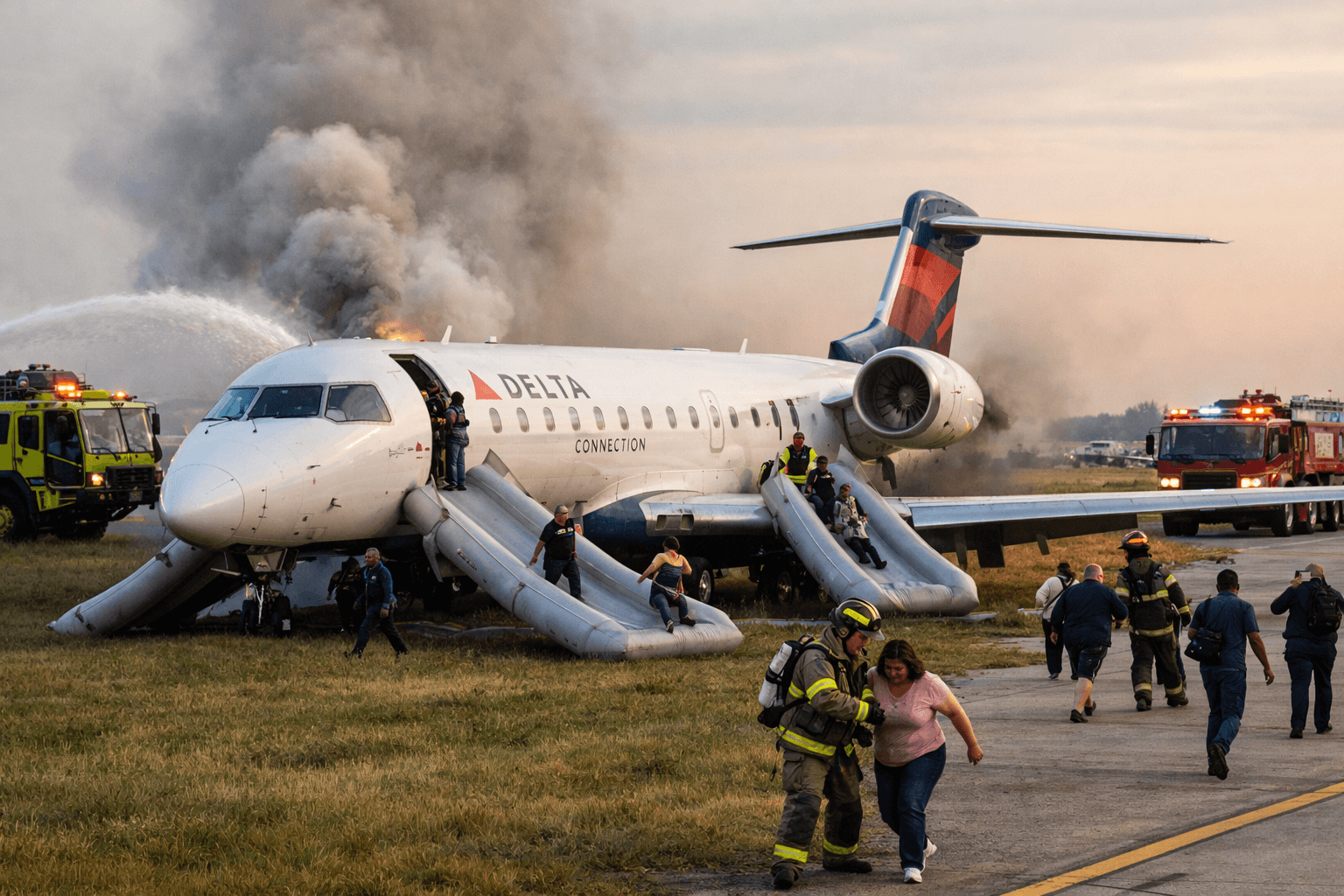
The notification flashed across flight tracking apps at 13:19 UTC on July 7, 2025: Delta Connection flight DL3543 was squawking 7700—the universal emergency transponder code. For passengers aboard the Embraer 170-200LR climbing out of Minneapolis-St. Paul International Airport, what began as a routine 90-minute hop to Chicago Midway suddenly transformed into something entirely different. The aircraft, just ten minutes into its ascent at 21,000 feet, halted its climb. The crew declared an emergency landing and began an immediate return.
For those watching from the ground, the fear was palpable. For those on board, the uncertainty was real. But what unfolded next wasn’t a catastrophe—it was a textbook demonstration of exactly why modern aviation remains one of the safest forms of travel on Earth.
This is the full story of the DL3543 emergency return, what triggered it, how the system responded, and what every traveler should understand about precautionary emergency landings.
What Happened During theDelta Connection DL3543 Emergency Landing?
On that Sunday morning, Delta Connection flight DL3543—operated by a regional carrier under the Delta brand—departed Minneapolis (MSP) bound for Chicago Midway (MDW)at 13:09 UTC. The Embraer 170-200LR aircraft, registration N259SY, carried passengers expecting nothing more eventful than complimentary beverages and a quick descent into Illinois.
Instead, barely ten minutes after takeoff, the flight crew encountered an operational alert in the cockpit. The exact nature of the technical issue hasn’t been publicly disclosed, but sources indicate it involved system warnings that warranted immediate attention. Following established protocols, the pilots made a decisive choice: declare an emergency and return to Minneapolis.
The Emergency Declaration andSquawk 7700
When pilots set their transponder to 7700, it’s aviation’s equivalent of raising a red flag. This emergency squawk code immediately notifies air traffic control (ATC) that the aircraft requires priority handling. Airspace is cleared. Emergency services are alerted. Landing slots are prioritized.
For flight DL3543, this meant:
- Immediate clearance to descend and return to Minneapolis
- Priority approach to runway 12R
- Emergency vehicles positioned on standby at the airport
- Full coordination between crew, ATC, and ground support
The aircraft touched down safely on runway 12R at Minneapolis just 37 minutes after initial departure. Passengers disembarked normally at gate C12, with no injuries reported. The emergency landing procedure had worked precisely as designed.
Why DidDelta Connection DL3543 Make anEmergency Return to Minneapolis?

Understanding why this unscheduled landing occurred requires understanding modern aviation’s safety-first philosophy: when in doubt, land.
The Role of Cockpit Alerts inFlight Emergency Decisions
Modern aircraft are equipped with sophisticated monitoring systems that constantly evaluate hundreds of parameters—engine performance, hydraulic pressure, electrical systems, fuel flow, cabin pressurization, and more. When any system detects an anomaly, it alerts the flight crew through warning lights, sounds, or cockpit displays.
Here’s what many passengers don’t realize: these alerts are designed to be conservative. A warning doesn’t necessarily mean something is failing—it means something requires evaluation. In the case of DL3543’s emergency diversion, the crew received an indication that a system might not be operating within normal parameters.
Why Airlines ChoosePrecautionary Emergency Landings
The aviation industry operates under a principle that might seem overly cautious to outsiders: resolve uncertainty on the ground, not in the air.
When faced with an ambiguous situation—a warning that could indicate anything from a minor sensor malfunction to an actual system issue—pilots don’t attempt diagnosis at 21,000 feet. They land the aircraft, allow maintenance teams to inspect thoroughly, and only continue once everything is verified.
This is exactly what happened with Delta Connection flight DL3543. The decision to return wasn’t made because the aircraft was in immediate danger. It was made because continuing the flight with an unresolved question mark was unacceptable.
TheFAA’s Guidance on Emergency Protocols
The Federal Aviation Administration (FAA) explicitly encourages this approach. Their guidance prioritizes early intervention over risk management at altitude. Pilots receive extensive training on when to declare emergencies, and the threshold is intentionally low—better to land safely and discover nothing was wrong than to continue and discover too late that something was.
UnderstandingDelta Connection: Regional Carriers and Safety Standards
One question frequently arises when discussing incidents like the DL3543 emergency landing: Are Delta Connection flights as safe as mainline Delta operations?
The answer is unequivocal: yes.
What isDelta Connection?
Delta Connection is the brand name Delta Air Lines uses for regional flights operated by partner carriers. These include:
- Republic Airways
- SkyWest Airlines
- Endeavor Air (wholly owned by Delta)
These regional operators fly smaller aircraft—typically Embraer regional jets like the E170/E175 or Bombardier CRJ series—on shorter routes. While the airline operating the flight may differ from mainline Delta, the safety regulations and standards do not.
Identical Safety Standards Across the Board
All Delta Connection carriers must comply with:
- The same FAA Part 121 regulations as major airlines
- Identical pilot training requirements
- The same aircraft maintenance protocols
- Equal oversight and safety audits
The notion that regional airline safety is somehow inferior is a myth. Aircraft size doesn’t determine safety—regulatory compliance, maintenance rigor, and crew training do. And in those areas, Delta Connection operations are held to the exact same standards as a widebody international Delta flight.
TheEmergency Landing Process: What Happens Behind the Scenes
When flight DL3543 declared an emergency, it triggered a coordinated response involving multiple teams working in perfect synchronization.
Step 1:Crew Communication and Decision-Making
The moment the cockpit alert appeared, the flight crew would have:
- Assessed the warning using established checklists
- Communicated with Delta’s operations center
- Consulted with maintenance specialists via radio
- Coordinated with air traffic control
- Made the decision to return
This entire process happens in minutes, sometimes seconds, with each team member executing their role with precision honed through countless training scenarios.
Step 2:Air Traffic Control Coordination
Once the emergency squawk 7700 was activated, Minneapolis ATC immediately:
- Cleared conflicting traffic from DL3543’s flight path
- Prioritized the aircraft for approach and landing
- Alerted airport emergency services
- Coordinated with other aircraft to maintain safe separation
Step 3:Ground Emergency Response
Even though the crew didn’t anticipate needing assistance, standard protocol meant:
- Fire and rescue vehicles positioned near the landing runway
- Medical personnel on standby
- Maintenance teams ready to inspect the aircraft post-landing
- Customer service representatives prepared to assist passengers
This full emergency response isn’t excessive—it’s preparedness. If something unexpected happens during landing, every resource needed is already in position.
Step 4:Safe Landing and Passenger Care
Flight DL3543 touched down smoothly and taxied to gate C12 without incident. Passengers deplaned normally, and Delta’s customer service teams immediately began rebooking travelers onto subsequent flights to Chicago.
For the airline, the operational disruption was significant—gates occupied longer than planned, crew schedules adjusted, connecting passengers rerouted. For passengers, the delay was frustrating. But everyone walked away safely, which is the only metric that truly matters.
Passenger Experience During anEmergency Landing: What to Expect
For anyone who has never experienced an in-flight emergency, the prospect can seem terrifying. Understanding what actually happens can ease that anxiety.
What Crews Tell Passengers
In most precautionary landing situations, cabin crew will:
- Provide calm, clear announcements explaining the situation
- Emphasize that the landing is being made out of an abundance of caution
- Instruct passengers to remain seated with seatbelts fastened
- Answer questions as information becomes available
The tone is professional and reassuring, not panicked. Crew members are trained to project calm even when managing their own stress.
Why You Might SeeEmergency Vehicles on the Ground
When passengers look out the window after an emergency landing and see fire trucks and ambulances, it’s easy to assume the worst. In reality, these vehicles are present as standard precautionary protocol, not because danger is imminent.
Their presence ensures that if any issue arises—smoke, fire, medical emergency—response is immediate. In the vast majority of cases, including DL3543, they’re never needed.
Passenger Rights andAirline Compensation
When flights are disrupted due to emergency diversions, passengers often wonder about their rights:
Rebooking: Airlines will rebook you on the next available flight at no additional cost.
Accommodations: If the delay extends overnight, hotels and meals are typically provided, though policies vary.
Compensation: In the U.S., airlines aren’t required to compensate for safety-related delays. However, many carriers, including Delta, offer goodwill gestures like travel vouchers.
Refunds: If you choose not to continue your journey, you’re generally entitled to a refund for the unused portion of your ticket.
HowAviation Technology MakesEmergency Landings Safer Than Ever
The DL3543 incident showcased how modern technology transforms aviation safety.
Real-TimeAircraft Monitoring Systems
Today’s aircraft are equipped with:
- Engine health monitoringthat detects performance degradation before it becomes critical
- Hydraulic system sensorsthat track pressure and temperature
- Electrical system diagnosticsthat identify potential failures
- Fuel monitoringthat ensures precise consumption tracking
- Flight data recordersthat capture every parameter for post-flight analysis
These systems provide pilots with unprecedented situational awareness, allowing them to make informed decisions based on hard data rather than guesswork.
Pilot Training and Simulation
Every commercial pilot undergoes regular simulator training that includes:
- Engine failures at various phases of flight
- Electrical system malfunctions
- Hydraulic failures
- Cabin depressurization scenarios
- Weather-related emergencies
These simulations are so realistic that pilots develop muscle memory for emergency procedures. When a real situation arises—like the alert that prompted DL3543’s emergency return—the response is automatic and effective.
Ground Support and Coordination
Modern airlines operate with 24/7 operations centers staffed by:
- Dispatchers who coordinate flight routing
- Maintenance experts who provide real-time technical support
- Meteorologists who monitor weather patterns
- Customer service teams ready to handle disruptions
When flight DL3543 encountered its issue, all these resources were immediately available to support the flight crew’s decision-making.
Delta Connection Safety Record: The Broader Picture
To understand the DL3543 emergency landing in context, it helps to examine the broader safety performance of regional aviation.
Regional Airline Safety Statistics
According to the National Transportation Safety Board (NTSB) and FAA data:
- Regional carriers operating under Part 121 regulations have safety records comparable to major airlines
- The accident rate for regional jets has declined consistently over the past two decades
- Modern Embraer and Bombardier regional jetshave excellent safety records
RecentDelta Connection Incidents
While flight DL3543 generated headlines, it’s worth noting that:
- The incident resulted in zero injuries
- The aircraft landed safely and was quickly returned to service after inspection
- Passengers were accommodated on subsequent flights with minimal overall disruption
This stands in stark contrast to truly serious incidents. When compared to events like Delta Connection Flight 4819, which experienced a hard landing in Toronto in February 2025 resulting in 21 injuries, the DL3543 emergency was a routine operational event managed exactly as procedures dictate.
Continuous Safety Improvements
Every emergency landing, even uneventful ones like DL3543, undergoes thorough review:
- Maintenance teams inspect the aircraft completely
- Flight data recorders are analyzed
- Crew debriefs are conducted
- If any procedural improvements are identified, they’re implemented fleet-wide
This culture of continuous improvement is why aviation becomes safer every year.
Media Coverage vs. Reality: WhyEmergency Landing Headlines Can Be Misleading
The DL3543 incident illustrates a common disconnect between aviation reality and public perception.
Why EveryEmergency Landing Makes News
In the age of social media and 24/7 news cycles:
- Flight tracking websites like Flightradar24and ADS-B Exchange allow anyone to monitor aircraft in real-time
- Emergency squawk codes trigger instant notifications
- Aviation enthusiast communities share information within minutes
- News outlets pick up stories and amplify them
A precautionary landing that would have passed unnoticed 20 years ago now generates dozens of articles and thousands of social media posts.
Understanding theTerminology
The phrase “emergency landing” encompasses a wide spectrum:
Precautionary Emergency Landing: Aircraft lands due to an abundance of caution, not imminent danger (like DL3543)
Emergency Return: Flight returns to departure airport shortly after takeoff
Emergency Diversion: Flight lands at an unplanned airport due to unforeseen circumstances
Forced Landing: Aircraft makes an unplanned landing due to inability to continue flying (rare)
Crash Landing: Aircraft lands in a damaged or uncontrolled state (extremely rare)
Most headlines use “emergency landing” to describe the first category—routine precautionary measures—but readers often interpret it as the last category.
TheEmotional Impact on Passengers
For passengers aboard flight DL3543, the experience was undoubtedly stressful. The anxiety of an unexpected return, the uncertainty about what’s wrong, the disruption to travel plans—all of these are real and valid concerns.
However, from a safety perspective, the event represented the system working perfectly. No one was in danger. The crew identified a potential issue and took the safest course of action. The aircraft landed normally. Everyone continued their journey.
WhatTravelers Should Know AboutEmergency Landings
If you ever find yourself aboard a flight that declares an emergency, here’s what you should remember:
Trust the Crew
Commercial airline pilots and flight attendants are among the most highly trained professionals in any field. Their emergency training is comprehensive, ongoing, and regularly evaluated. When they say they’re landing out of caution, believe them.
Emergency Declarations Are Common
Thousands of flights operate daily across the United States alone. Emergency returns and precautionary landings happen far more frequently than most people realize—multiple times per day across the national airspace system. The vast majority conclude without incident.
Modern Aircraft Are Built for This
Today’s commercial jets are designed with multiple redundancies. Most systems have backups. If one engine fails, the aircraft can fly safely on the other. If one hydraulic system loses pressure, others can compensate. The Embraer 170 that operated flight DL3543 is designed to handle emergencies and land safely even with multiple system failures.
Your Airline Will Take Care of You
In the event of a flight disruption due to an emergency landing:
- You’ll be rebooked on another flight
- If delays extend significantly, meals and accommodations are typically provided
- Customer service teams are trained to handle these situations
While frustrating, these disruptions are manageable, and airlines have well-established procedures for passenger care.
TheJuly 7, 2025 Delta Connection DL3543 Emergency Landing: Final Thoughts
What happened to Delta Connection flight DL3543 on July 7, 2025, wasn’t a failure—it was a success. The aircraft experienced a cockpit alert. The crew evaluated the situation. They made a conservative decision to return to Minneapolis. They landed safely. Every passenger walked off the aircraft unharmed. This is exactly how the system is supposed to work.
In an era where airline incidents dominate headlines and social media, it’s easy to forget just how safe commercial aviation actually is. The DL3543 emergency serves as a reminder that when we hear about emergency landings, we’re usually witnessing the industry’s commitment to safety in action—not evidence of danger.
Key Takeaways About theDelta Connection DL3543 Incident:
✈️ The emergency return was precautionary, not due to immediate danger
✈️ The crew followed established safety protocols exactly as trained
✈️ Delta Connection flights operate under the same strict FAA regulations as mainline carriers
✈️ Modern aircraft monitoring systems allow crews to detect and respond to issues proactively
✈️ Emergency landings are a normal part of aviation’s safety-first culture
✈️ All passengers were safely accommodated on subsequent flights to Chicago
✈️ The Embraer 170 aircraft was inspected, cleared, and returned to service
Frequently Asked Questions
Was theDL3543 emergency landing dangerous?
No. The emergency return was a precautionary measure. The crew identified a potential issue and chose to land out of an abundance of caution. There was no immediate danger to the aircraft or passengers.
AreDelta Connection flights less safe than mainline Delta flights?
No. Delta Connection carriers operate under the exact same FAA Part 121 regulations as major airlines. Pilot training, aircraft maintenance, and safety standards are identical regardless of aircraft size or route length.
What caused theDelta Connection DL3543 to return to Minneapolis?
While specific details haven’t been publicly disclosed, the flight returned due to a cockpit alert indicating a potential operational concern. Following standard protocols, the crew elected to land and have maintenance teams evaluate the issue on the ground.
How often doemergency landings happen?
More frequently than most people realize. Across the thousands of daily flights in the U.S. alone, precautionary emergency landings occur multiple times per day. The vast majority conclude safely and receive little media attention.
Can passengers get compensation foremergency landing delays?
In the United States, airlines aren’t legally required to provide compensation for safety-related delays. However, passengers are entitled to rebooking on the next available flight, and many carriers offer goodwill gestures such as meal vouchers or travel credits.
What doessquawk 7700 mean?
Squawk 7700 is the transponder code that pilots use to indicate an emergency. It immediately alerts air traffic control that the aircraft requires priority handling and ensures that the flight receives expedited clearance for landing.
Is it safe to fly onregional jets like theEmbraer 170?
Yes. Modern regional jets manufactured by Embraer and Bombardier meet the same rigorous safety standards as larger aircraft. They undergo the same certification processes, maintenance requirements, and operational oversight.
Final Thoughts
If there’s one lesson to take from the Delta Connection DL3543 emergency landing, it’s this: the system works.When a potential issue arose, it was detected immediately. The crew was alerted. They consulted with ground support. They made the safest decision. Air traffic control provided priority handling. Emergency services were ready. The aircraft landed safely. Passengers were cared for.
At every step, from the initial cockpit alert to the final passenger rebooking, the process unfolded exactly as designed. This wasn’t luck—it was the result of decades of safety culture development, rigorous training, advanced technology, and unwavering commitment to passenger safety.
The next time you see a headline about an emergency landing, remember flight DL3543. Remember that what sounds alarming in a news alert is often routine in aviation. Remember that every emergency declaration, every precautionary return, every unexpected diversion represents an industry choosing safety over schedules, caution over efficiency, and lives over profits. That’s not a system failing—that’s a system working exactly as it should.