
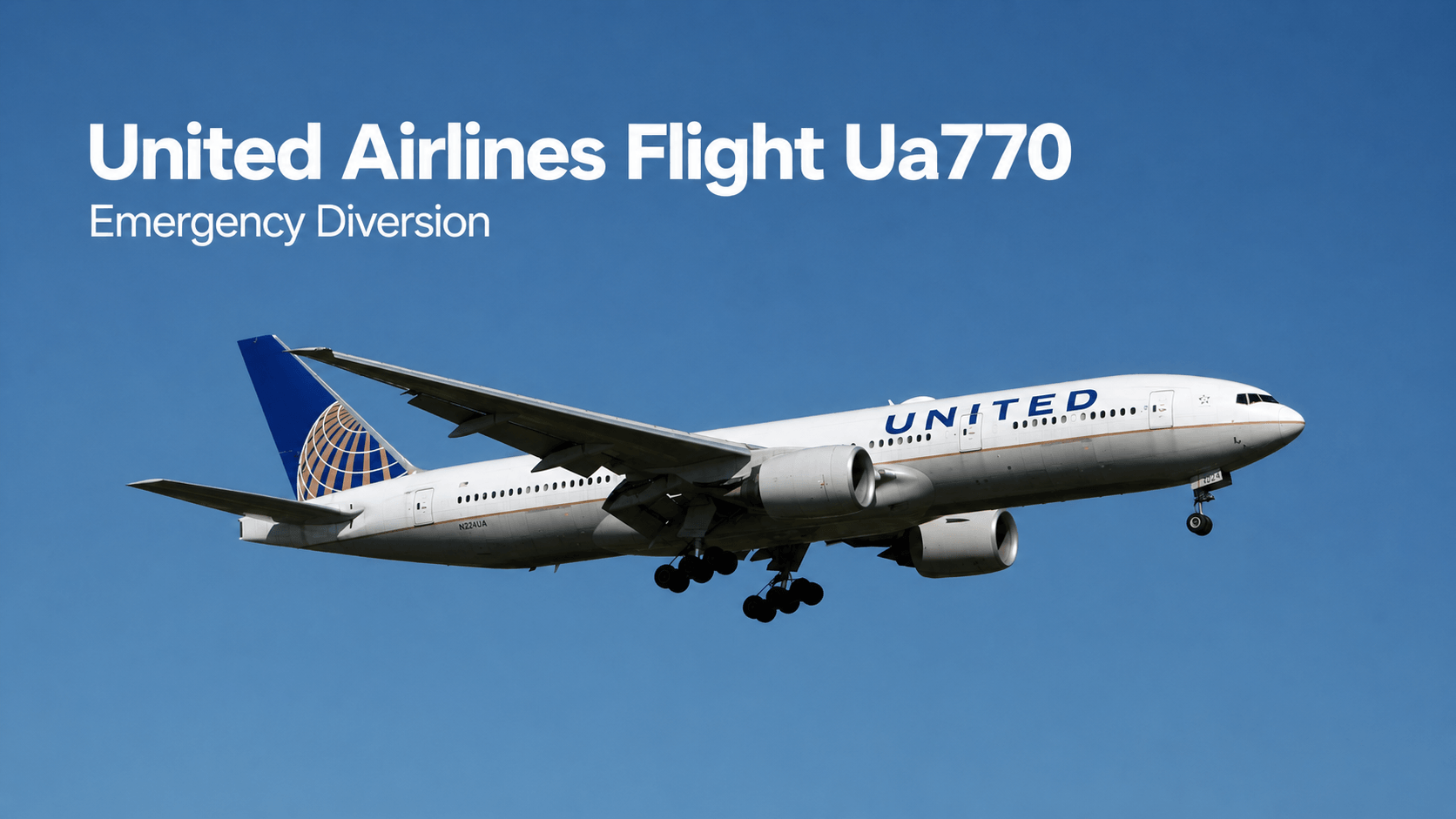
Somewhere over the North Atlantic on the afternoon of May 27, 2025, a United Airlines Boeing 787-9 Dreamliner quietly changed course. The plane was supposed to land in Chicago. It didn’t. Instead, it made its way to London Heathrow — and when it touched down, 257 passengers and 12 crew members walked away without a scratch.
This is the complete story of the United Airlines Flight UA770 emergency diversion: what triggered it, how the crew responded, why Heathrow was the right call, and what the whole incident actually tells us about the safety systems keeping us alive at 37,000 feet.
“The diversion wasn’t a failure. It was the system working perfectly.”
What Was Flight UA770, Exactly?
UA770 is a regularly scheduled transatlantic route operated by United Airlines, connecting Barcelona’s El Prat Airport with Chicago O’Hare International Airport. On May 27, 2025, the aircraft assigned to the route was a Boeing 787-9 Dreamliner — registration N26902 — a wide-body jet that’s been one of the workhorses of long-haul air travel since its introduction.
The flight had taken off from Barcelona without incident. Passengers settled in for the roughly 10-hour haul across the Atlantic. Nothing unusual. Routine transatlantic service.
That changed about 90 minutes into the flight.
What is Squawk 7700?
When a pilot wants to signal a general emergency to air traffic control, they transmit transponder code 7700 — universally known as “squawking 7700.” It’s an invisible flag broadcast from the aircraft that instantly alerts controllers and nearby planes. Once transmitted, the flight gets priority handling: clear airspace, expedited routing, and emergency services on standby at the destination. It’s one of aviation’s most important signals, and using it is never taken lightly.
The Moment Everything Changed: A Pressurization Alert
Cruising at approximately 37,000 feet over the North Atlantic, the flight deck received a caution related to the cabin pressurization system. On the surface, that might not sound alarming. But pressurization is one of the most critical systems on any high-altitude aircraft.
Here’s the thing most passengers don’t fully appreciate: at that altitude, the outside air is so thin and so cold that it’s essentially unbreathable without the artificial environment created inside the fuselage. The pressurization system maintains cabin altitude at roughly 6,000–8,000 feet equivalent — comfortable, breathable air — even while the plane screams through the stratosphere.
If that system fails or behaves abnormally, it can escalate from uncomfortable to life-threatening. Fast. The pilots knew this. So when the alert appeared, they didn’t wait to see if it would resolve itself.
The captain and first officer ran through their checklists — a methodical, practiced sequence that pilots drill until it becomes instinct. They contacted air traffic control, coordinated with United’s operations team on the ground, and made the call: declare an emergency and divert to the nearest suitable airport.
That airport was London Heathrow.
Flight Timeline — May 27, 2025
| Takeoff | UA770 departs Barcelona El Prat for Chicago O'Hare. Routine transatlantic service begins. |
|---|---|
| ~90 min in | Cockpit receives pressurization system alert at 37,000 ft over the North Atlantic. Checklist procedures initiated immediately. |
| Alert response | Crew squawks 7700 (general emergency). Coordination with ATC and United operations. London Heathrow selected as diversion airport. |
| ~4:55 PM BST | Aircraft lands on Runway 27R at London Heathrow. Emergency services on standby — none required. |
| Post-landing | Aircraft taxies to Gate B44. Passengers assisted. Rebooking begins. Technical inspection initiated on N26902. |
Why London Heathrow? The Logic Behind the Decision

When a transatlantic flight needs to divert, the crew doesn’t just pick the closest dot on the map. The decision is a calculated assessment involving multiple factors — runway length, maintenance capability, emergency infrastructure, and the ability to handle hundreds of displaced passengers.
Heathrow checked every box.
Why Heathrow Was the Right Call
- → Long runways capable of handling wide-body aircraft like the 787-9 with full emergency services
- → Round-the-clock Boeing 787 maintenance capability and engineering resources
- → One of the busiest and best-equipped airports in the world for passenger recovery and rebooking
- → Geographically sensible — closer than turning back to mainland Europe or continuing across the ocean
- → Robust hotel, ground transportation, and consular infrastructure for international passengers
The aircraft landed smoothly on Runway 27R. Emergency services were standing by at the runway threshold — standard procedure for any declared emergency — but they weren’t needed. The plane taxied normally to Gate B44, and passengers disembarked without incident.
What Did Passengers Experience on Board?
One of the most telling aspects of this incident is how calm the cabin remained throughout. Passengers later described a very different experience than the dramatic movie-style emergency most people imagine when they hear the words “in-flight emergency.”
“We were halfway through the flight, and the captain came on. He said something about a technical irregularity and that we’d be landing in London as a precaution. The flight attendants were calm. There was no panic.” — Passenger account, as reported in post-incident coverage
No oxygen masks dropped. No sudden descent. Cabin pressure was maintained throughout the flight, meaning passengers never experienced the physiological effects of depressurization. The alert was a warning — a precautionary signal that something might be developing — not an actual loss of pressure.
This is precisely how the system is supposed to work. Modern aircraft like the 787-9 are engineered to detect problems early, giving crews time to act before situations escalate. The drama, in this case, happened on checklists and radio frequencies — not in the cabin.
The Boeing 787-9: Why This Aircraft’s Design Matters
The Boeing 787-9 Dreamliner isn’t just any plane. It was specifically designed with passenger comfort — including cabin pressurization — as a core engineering priority. Unlike older aluminum-fuselage jets, the 787’s composite carbon-fiber structure allows for higher cabin humidity and a lower pressurization altitude, making long flights noticeably more comfortable.
The aircraft is also packed with redundant safety systems. If one sensor gives an anomalous reading, backup sensors cross-check the data. Multiple systems monitor multiple systems. This layered approach is part of why the crew received an early warning — the aircraft literally told them something was off before any real problem could develop.
Aircraft cabins are pressurized by bleeding compressed air from the engines (or, on the 787, from dedicated electric compressors). This air fills the sealed fuselage to maintain a pressure equivalent to roughly 6,000–8,000 feet above sea level. Sensors continuously monitor pressure levels, differential pressure, and airflow rates. Any deviation from normal operating parameters triggers alerts in the cockpit — graded by severity. The UA770 alert was precautionary: the system flagged an anomaly before it became a genuine crisis.
The UA770 Story Is Actually Three Stories
If you’ve been searching this topic and found conflicting information, there’s a reason: the flight number UA770 was involved in more than one notable incident during 2025. Understanding the distinction matters.
Barcelona → Chicago, Diverted to Heathrow
The primary incident covered in this article. Boeing 787-9 Dreamliner (N26902) declares emergency over the North Atlantic due to cabin pressurization alert. Safe landing at London Heathrow. All 257 passengers and 12 crew unharmed.
San Francisco → Chicago, Diverted to Denver
A separate UA770 operation diverted to Denver over the Rocky Mountains after pilots received a hydraulic system warning. Different aircraft, different route, same flight number. Safe landing with no injuries reported.
Los Angeles → Chicago, Diverted to Denver
A Boeing 737 MAX 9 on the LA-Chicago UA770 routing diverted to Denver after a sensor alert approximately 90 minutes into the flight. FAA requested a post-flight report. Aircraft underwent joint Boeing-United inspection. No injuries.
The fact that three separate UA770 incidents happened within months of each other on different aircraft and routes is mostly a coincidence of schedule — flight numbers are reused daily. But it did create a perfect storm for media coverage and public anxiety, which is worth acknowledging honestly.
How the Crew’s Training Made All the Difference
Aviation professionals will tell you: a diversion like this isn’t a failure. It’s a success. The system detected a problem. The crew responded correctly. The plane landed safely. Everyone went home.
That outcome doesn’t happen by luck. It happens because of something called Crew Resource Management — or CRM — a structured approach to how pilots, copilots, and cabin crew communicate, distribute tasks, and make decisions under pressure. Modern CRM was developed after a series of accidents in the 1970s and 80s revealed that many crashes weren’t caused by mechanical failure or bad weather. They were caused by poor communication and hierarchical cockpit cultures where junior officers were afraid to speak up.
Today, every commercial flight crew is trained extensively in CRM. They run through emergency scenarios in simulators until their responses are automatic. They practice declaring emergencies, running checklists, communicating with ATC, and briefing passengers — all simultaneously and under simulated stress.
When the UA770 crew squawked 7700, it wasn’t a panicked reaction. It was a professional judgment call made swiftly and executed cleanly. That’s the difference between a tragedy and a non-event.
What Happens After a Diversion? The Passenger Experience
Landing safely is just the beginning of the logistical challenge. Once UA770 was on the ground at Heathrow, United Airlines kicked into gear to manage the aftermath — 257 passengers who expected to be in Chicago were now in London, many with connecting flights, meetings, or events they’d miss.
The airline provided meal vouchers and hotel accommodations where overnight stays were necessary. Passengers were rebooked on the next available United flights to Chicago, with priority given to those with urgent connections. The affected aircraft — tail number N26902 — was taken out of service for a thorough technical inspection before being cleared to fly again.
For travelers, the frustration of a diversion is real. But understanding your rights helps. Under EU regulations (since Barcelona is an EU departure point), passengers on diverted or significantly delayed international flights are generally entitled to meals, refreshments, and hotel accommodation during the wait — regardless of the reason for the disruption.
Is It Safe to Fly on Diverted Routes or Flagged Aircraft?
This is the question many passengers quietly ask after reading about incidents like this — and it deserves a straight answer.
Yes, Aviation’s safety record is extraordinary precisely because of how seriously every anomaly is treated. The pressurization alert on UA770 didn’t mean the plane was about to fail. It meant the aircraft’s monitoring systems caught an irregularity and the crew responded by choosing the most conservative, safest course of action available to them.
After any incident or diversion, the aircraft undergoes an inspection process that clears it to fly only when maintenance engineers are satisfied. This is regulated, documented, and overseen by aviation authorities. The 787-9 involved in the May 27 diversion was not returned to service until that inspection was complete.
Commercial aviation remains, statistically, the safest form of long-distance travel on earth. The UA770 story — uncomfortable as it felt in the moment for those on board — is actually evidence of that fact, not a contradiction of it.
“A diversion is proof the safety net works. The drama is the system functioning exactly as designed.”
What Aviation Experts Are Saying
Aviation safety analysts who reviewed the UA770 incidents were broadly consistent in their assessment: the crew acted correctly, the aircraft performed as designed, and the outcomes — in every case — were exactly what the industry strives for.
The incidents also reignited conversations about transparency between airlines and passengers. In a world where people can track flights in real time on their phones, vague explanations like “technical irregularity” tend to fuel speculation rather than calm it. Several aviation commentators argued that clearer, more detailed post-incident communication from United — while protecting operationally sensitive information — would have helped reduce the wave of anxiety that followed each diversion.
It’s a valid point. Informed passengers are calmer passengers. And calmer passengers are easier to manage during unexpected disruptions.
Key Takeaways from the UA770 Incidents
What This Incident Teaches Us
01Modern aircraft detect problems early — often before they become dangerous — and alert crews with time to respond.
02Declaring an emergency (Squawk 7700) is a precautionary tool, not a sign of catastrophic failure. Crews are trained to use it whenever there’s any doubt.
03Diversion airport selection is a calculated, multi-factor decision — not a guess. Heathrow’s infrastructure made it the optimal choice for a transatlantic wide-body diversion.
04Crew Resource Management is the invisible backbone of aviation safety. Calm, professional handling of emergencies saves lives.
05 A successful diversion with zero injuries is, by every measure, a good outcome — even if it doesn’t feel that way to frustrated passengers.
Here’s the honest bottom line: United Airlines Flight UA770’s emergency diversion on May 27, 2025 was, from a safety perspective, a textbook success. A system flagged an anomaly. A well-trained crew took decisive action. An aircraft landed safely. Every person on board went home.
The story that went viral — the one that generated thousands of searches and heated forum debates — was really a story about aviation working the way it’s supposed to. That’s worth saying clearly, even if it doesn’t make for quite as dramatic a headline.
The sky remains one of the safest places you can be. Not because nothing goes wrong up there — but because when it does, people like the UA770 crew know exactly what to do about it.
Frequently Asked Questions
What caused the United Airlines Flight UA770 emergency diversion on May 27, 2025?
Were any passengers or crew injured in the UA770 diversion?
Why are there multiple UA770 incident reports from 2025?
What is Squawk 7700, and how serious is it?
Should I be worried about flying on United Airlines or Boeing 787-9 aircraft after this incident?