

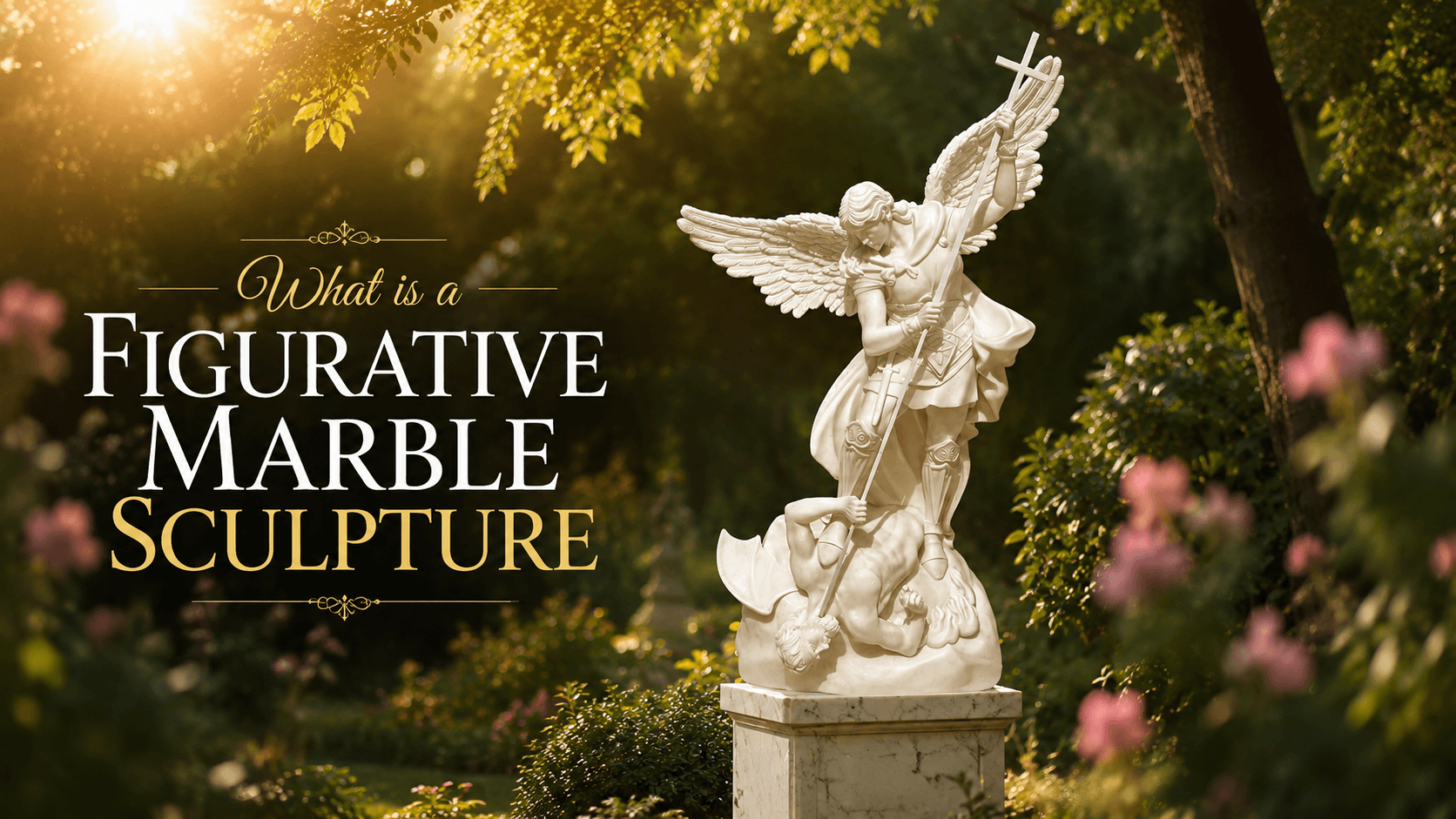
A figurative marble sculpture is a three-dimensional work carved from marble that represents a recognizable subject, most often the human figure. It may show an entire body, a portrait bust, a religious or mythological character, or a figure whose form has been simplified without becoming completely abstract. The term “figurative” generally refers to art that maintains a recognizable connection with the real world, particularly the human body.
What makes these sculptures distinctive is the meeting of two things: recognizable form and natural stone. The artist must understand proportion, pose, anatomy, gesture, and expression while also working within the physical limits of a block that cannot simply be rebuilt once material has been removed.
What Does “Figurative” Mean in Sculpture?
Figurative sculpture represents something viewers can recognize rather than relying entirely on non-representational shapes. A figure does not have to look photographic or perfectly realistic to qualify. Simplified, elongated, fragmented, or stylized bodies can still be figurative when their connection to a person or another recognizable subject remains clear.
That creates an important distinction between figurative and abstract art.
| Figurative sculpture | Abstract sculpture |
| Retains recognizable forms | May avoid recognizable subjects |
| Often focuses on people or bodies | Often emphasizes shape, volume, line, or material |
| Can be realistic or stylized | Can be geometric or organic |
| Gesture and anatomy may carry meaning | Form itself may carry much of the meaning |
Modern figurative art can therefore exist somewhere between strict realism and complete abstraction rather than belonging to only one traditional style.
Why Is Marble So Closely Connected With the Human Figure?
Marble is a metamorphic stone that has been used extensively for carving and architectural work. Its crystalline structure allows skilled sculptors to shape smooth transitions as well as sharply defined details, although stone remains brittle and mistakes can be difficult or impossible to reverse.
Its visual qualities are especially effective when representing skin, fabric, hair, and soft anatomical forms. Museum examples also demonstrate how carefully carved or thinned marble can create an impression of translucency, helping artists make hard stone suggest soft flesh or delicate fabric.
That contrast is part of the fascination: a viewer knows the object is stone, yet a skilled carving can suggest tension in a muscle, pressure in a hand, or the weight of cloth falling across a body.
Different stones also change the appearance of the finished figure. White Carrara marble has long been associated with European sculpture, while other white, gray, black, beige, and strongly veined marbles can give a figure a very different visual character.
How Is a Figurative Marble Sculpture Made?
Creating a marble figure is fundamentally a subtractive carving process. Instead of building the form by adding material, the sculptor removes stone until the desired figure remains. The National Gallery of Art describes carving as a subtractive technique in which tools such as chisels and abrasives remove material from hard substances such as stone.
A traditional workflow may involve several stages:
- Develop the design.The sculptor may begin with drawings or a small clay model.
- Create a larger model.Complex works can be studied at full scale before carving begins.
- Transfer measurements.Reference points help establish major proportions in the marble block.
- Rough out the figure.Large amounts of excess stone are removed first.
- Refine anatomy and drapery.Smaller tools establish faces, hands, folds, hair, muscles, and other details.
- Finish the surface.Abrasives can create anything from a textured matte surface to a highly polished finish.
The celebrated sculptor Antonio Canova, for example, developed designs in clay and used plaster models and a mechanical pointing system to transfer measurements into marble. The Smithsonian American Art Museum also documents the use of the pointing machine by American sculptors such as Hiram Powers.
Common Types of Figurative Marble Sculpture
A figurative work can take several forms, and understanding the format is often more useful than simply judging it by size.
Full-Body Figures
Standing, seated, kneeling, or reclining figures show how the whole body carries weight and movement. A pose such as contrapposto, in which the body’s weight is shifted primarily onto one leg, can make a static stone figure appear more relaxed and naturally balanced. The National Gallery notes this stance in its discussion of classical influence on later marble sculpture.
Portrait Busts
A portrait bust typically concentrates attention on the head and upper torso. Because there is less body movement to read, expression, hairstyle, facial structure, gaze, and surface treatment become especially important.
Religious and Mythological Figures
Gods, saints, angels, biblical characters, and allegorical figures have long provided sculptors with subjects through which they could explore beauty, heroism, grief, devotion, or moral ideas.
Contemporary Figurative Work
Contemporary sculptors are not limited to classical realism. A modern marble figure may deliberately simplify the face, fragment the torso, exaggerate proportions, or leave sections rough so that the original block remains visually present.
A Short History of Figurative Marble Sculpture
The connection between marble and the body reaches far beyond the Renaissance. Ancient Greek sculpture established influential approaches to proportion, pose, movement, and idealized anatomy, while Roman sculptors created portraits and adapted many earlier Greek forms.
The Venus de Milo, dating to the Hellenistic period, is a famous surviving example. The Louvre notes that the figure was carved from separate blocks of Parian marble, demonstrating that major marble sculptures were not necessarily produced from one uninterrupted block.
During the Renaissance, Michelangelo pushed large-scale marble carving in new directions. His David, made between 1501 and 1504 from white marble and measuring 517 centimeters high, remains one of the clearest examples of the human body used as both subject and expressive structure.
Figurative marble also became important in American art. Hiram Powers, an American sculptor working in Florence, became internationally known for The Greek Slave, a life-size marble figure modeled in the 1840s. His studio used assistants and pointing technology to produce marble versions of his designs.
One detail modern viewers sometimes miss is polychromy. The clean white surfaces associated with classical sculpture today do not necessarily reflect their original appearance; museum research confirms that many ancient Greek and Roman marble sculptures were once colored.
How Can You Judge the Quality of a Marble Figure?
Do not judge a figurative sculpture only by how many small details it contains. More detail does not automatically mean better carving.
Instead, look at how the entire figure works together:
- Does the pose feel balanced rather than stiff?
- Does the anatomy make sense beneath clothing?
- Do hands and feet feel integrated with the body?
- Does draperyrespond naturally to gravity and movement?
- Are facial features expressive without appearing mechanically repeated?
- Does the surface finishsupport the subject?
- Do the stone’s natural veins complement rather than distract from important facial or anatomical areas?
Look at the work from several angles. Sculpture exists in three dimensions, so a piece that works only from the front may feel much less convincing when viewed from the side or rear.
Choosing and Placing a Figurative Marble Sculpture
For a home, garden, memorial, or collection, start with the intended location rather than buying solely because a subject looks attractive.
Consider scale, viewing distance, natural and artificial light, floor strength, pedestal stability, access for installation, and the visual relationship between the figure and its surroundings. A detailed portrait bust rewards close viewing, while a larger standing figure may need considerably more space around it to read clearly.
For valuable antique, historic, or artist-attributed works, provenance and condition should also be examined carefully. Repairs, cracks, replaced sections, weathering, and previous cleaning treatments may matter just as much as the visual design.
How Should Marble Sculpture Be Cared For?
Marble may survive for very long periods, but that does not make it indestructible. Outdoor stone is affected by moisture, salts, biological growth, pollution, and freeze-thaw cycles, while unsuitable cleaning can accelerate deterioration. The U.S. National Park Service specifically warns that improper products and aggressive cleaning practices can damage marble surfaces.
For ordinary indoor pieces, gentle dust removal is safer than experimenting with strong household chemicals. Valuable, historic, stained, cracked, or heavily weathered sculpture should be assessed by a qualified stone conservation professional before intensive cleaning or restoration.
FAQs
Is a figurative marble sculpture always realistic?
No. A sculpture can remain figurative even when its proportions or forms are simplified or stylized. The key is that a recognizable connection to a real-world figure remains.
Is every marble statue a figurative sculpture?
No. Marble can also be carved into abstract sculpture, reliefs, architectural ornament, vessels, fountains, and other non-figurative forms.
Are marble figures always carved from one block?
No. Some famous sculptures consist of separately carved marble sections. The Louvre documents multiple joined blocks in the Venus de Milo.
Why do old marble sculptures often appear white?
The white stone may survive while surface decoration does not. Evidence shows that numerous ancient marble statues originally included painted or tinted details.
Can a marble sculpture be displayed outdoors?
Yes, but the specific stone, climate, drainage, installation, previous condition, and exposure all matter. Outdoor marble should not be treated as maintenance-free, particularly in areas with repeated freezing, moisture, salts, or biological growth.
Understanding the Figure Beyond the Stone
A figurative marble sculpture is more than a realistic statue made from an expensive material. It is the result of an artist translating recognizable bodies, gestures, expressions, and ideas into stone through controlled removal of material.
Learning to notice anatomy, balance, drapery, toolwork, finish, stone quality, and viewing angle changes how these works are understood. Once those elements become visible, the viewer is no longer simply asking what the sculpture represents, but how an artist managed to make an immovable block appear to breathe, bend, rest