
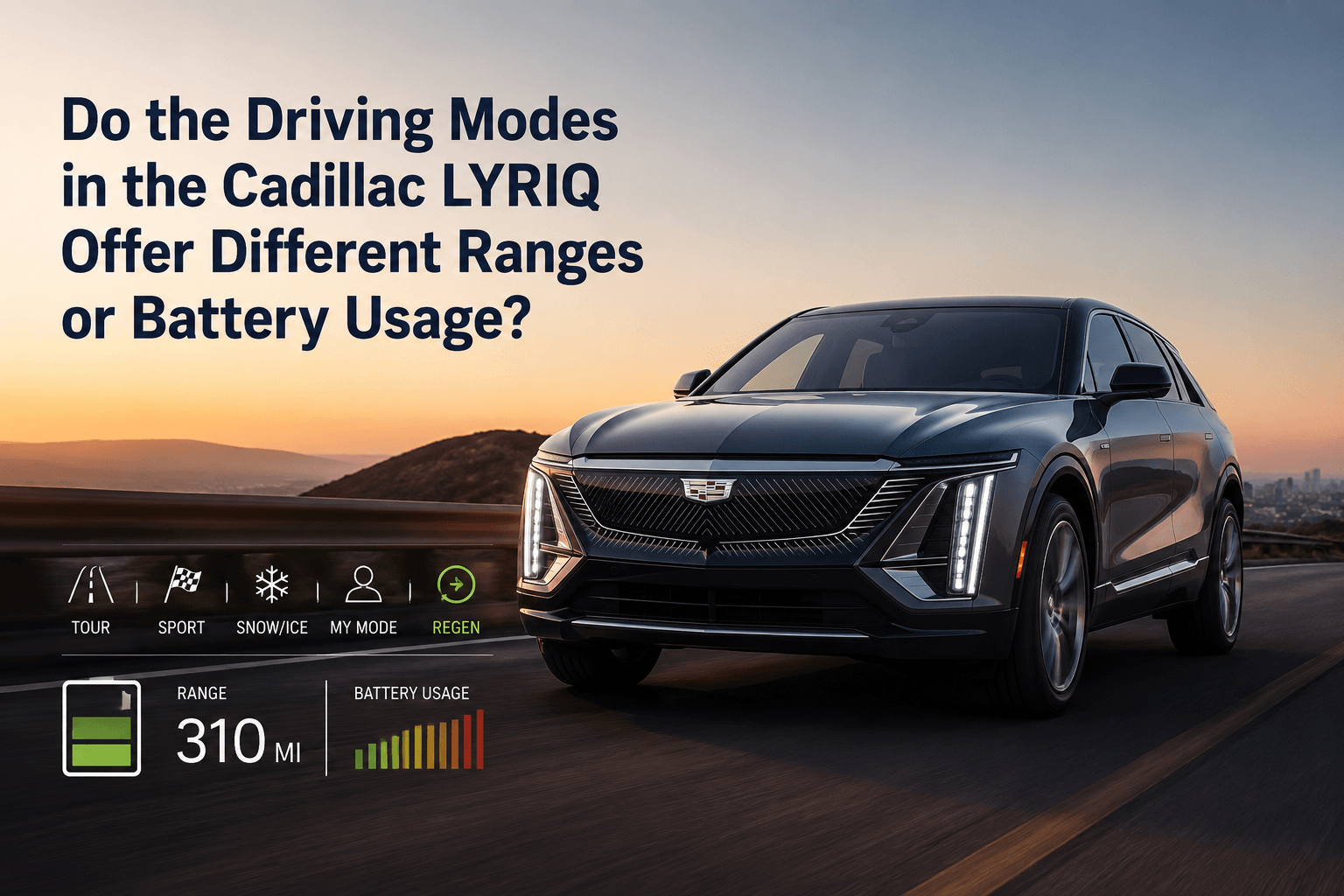
Short answer: yes — but not always in the way you’d expect. The LYRIQ’s driving modes change how aggressively the car draws power, which absolutely affects efficiency. Here’s the full picture.
Why Driving Modes Matter in an EV
In a gas car, switching to a sport mode mostly just remaps the throttle and stiffens the suspension. You notice it in feel, not so much in fuel bills. In an electric vehicle like the Cadillac LYRIQ, driving modes do something more meaningful — they change how the motor controller interprets your inputs, how regenerative braking behaves, and in some cases, how the car manages cabin climate. All of that adds up to real differences in how far you can go on a single charge.
The LYRIQ comes with four main drive modes: Tour, Sport, Snow/Ice, and My Mode. Each one creates a genuinely different relationship between driver input and energy consumption.
Think of driving modes less as performance presets and more as energy budgets. Some modes spend freely; others pinch every kilowatt-hour.
The Four Cadillac LYRIQ Driving Modes, Explained

Tour Mode
The everyday default. Balanced throttle response, moderate regen, optimized for range. Best for commutes and highway driving.
Sport Mode
Sharpened throttle, more responsive steering, firmer damping. Power delivery increases noticeably. Range takes a hit.
Snow / Ice Mode
Reduces torque output and modulates wheel spin for slippery surfaces. Can actually improve efficiency in bad conditions.
My Mode
Fully customizable. You pick the throttle feel, regen level, steering weight, and suspension. Range depends on your choices.
Tour Mode — The Range Champion
When Cadillac rates the LYRIQ at up to 314 miles of EPA-estimated range (on RWD single-motor trim), that figure is calculated with regular, efficiency-oriented driving — the kind Tour Mode is designed for.
In Tour Mode, the throttle mapping is linear and measured. You won’t feel a surge of power when you press the accelerator; instead, the car eases into acceleration smoothly. The regenerative braking is set at a moderate level, recovering energy as you lift off the pedal without being so aggressive that it feels jerky. Suspension and steering are comfortable rather than firm.
For the majority of daily driving — city loops, suburban errands, highway cruising — Tour Mode is the sweet spot between comfort and range. If you’re focused on getting maximum miles per charge, this is your default.
Use Tour Mode on the highway and consider setting one-pedal driving on inside My Mode for city driving. The combination can meaningfully extend your effective range between charges.
Sport Mode — Performance at a Price
Sport Mode in the LYRIQ is genuinely fun. The throttle response sharpens considerably — inputs feel more direct, and the car’s dual-motor AWD variant in particular rewards the sportier setup with faster, more confident acceleration. Steering weight increases, the suspension firms up, and the whole car feels more planted.
But electric motors respond to throttle maps with almost zero latency. When Sport Mode tells the controller to deliver power more eagerly, the battery delivers more eagerly — and range decreases as a result. How much? Real-world tests and owner reports suggest you can expect roughly a 10–20% reduction in range when driving Sport Mode with any enthusiasm. If your RWD LYRIQ normally shows 280 miles of estimated range at a given charge level, sustained Sport driving could pull that closer to 230–250 miles.
That said, if you’re driving Sport Mode conservatively — not mashing the accelerator, just enjoying the tighter feel — the range penalty shrinks. The mode enables performance; your right foot decides whether to use it.
Snow / Ice Mode — Smart for Slippery Days
This one surprises people. Snow/Ice Mode reduces the torque delivered to the wheels to prevent slipping, effectively making the car gentler in its power delivery. On icy roads, that’s exactly what you want — but it also means the car isn’t hammering the battery with sudden high-power demands.
In practice, Snow/Ice Mode can actually be more efficient than Sport Mode and sometimes comparable to Tour Mode in very slippery conditions where you’d otherwise fight wheelspin. It also tends to encourage a slower, more deliberate driving pace, which helps range.
The important context: cold weather itself is a major range reducer for any EV. The LYRIQ’s lithium-ion battery pack is less efficient when cold, and heating the cabin draws power too. So while the mode itself is energy-sensible, winter range will still be lower than summer range regardless of mode selection.
My Mode — Your Efficiency, Your Call
My Mode is where the LYRIQ gets genuinely interesting for the thoughtful driver. Through the infotainment system, you can adjust:
- Throttle response (from Tour-like smoothness to Sport-like sharpness)
- Regenerative braking intensity (low, medium, or high — enabling one-pedal driving at the highest setting)
- Steering effort
- Suspension tuning (on models with adaptive dampers)
From a pure range perspective, the single most impactful setting in My Mode is regenerative braking. Setting regen to maximum means the motor aggressively harvests energy every time you lift off the pedal. In stop-and-go city traffic, this is a meaningful efficiency gain — you’re essentially turning deceleration into stored electricity rather than wasted heat through brake pads.
A common efficient My Mode setup for city driving: smooth throttle response, maximum regenerative braking, lighter steering. You get comfort, one-pedal driving capability, and improved energy recovery.
Regenerative braking intensity is the single biggest efficiency lever available in My Mode. In city traffic, high regen can recover a surprising amount of energy per mile.
How Each Mode Compares: A Practical Summary
| Mode | Throttle Feel | Default Regen | Range Impact | Best Use Case |
|---|---|---|---|---|
| Tour | Smooth, balanced | Moderate | Baseline (best) | Daily commute, highway |
| Sport | Sharp, responsive | Moderate | –10 to –20% (driven hard) | Spirited driving, canyon roads |
| Snow/Ice | Muted, controlled | Moderate | Comparable to Tour | Slippery winter roads |
| My Mode | Customizable | Adjustable | Depends on settings | Personalized daily use |
Other Factors That Affect LYRIQ Range (Beyond Modes)
Driving modes are one piece of the efficiency puzzle. A few other variables matter just as much — sometimes more:
- Speed: Highway driving above 75 mph dramatically increases aerodynamic drag and reduces range. The LYRIQ’s EPA range is calculated at mixed speeds; heavy highway use will lower it.
- Temperature: Cold weather can reduce range by 20–40% on any EV. The LYRIQ uses battery conditioning to mitigate this, but it’s unavoidable physics.
- Climate control: Running the heater draws significant battery power in winter. The heat pump in some LYRIQ trims helps reduce this draw compared to a resistive heater.
- Acceleration habits: Hard launches — regardless of mode — consume significantly more energy than gentle acceleration. A calm Sport Mode driver may use less energy than an aggressive Tour Mode driver.
- Tire pressure: Under-inflated tires increase rolling resistance. Keep them at the recommended PSI for meaningful efficiency gains.
RWD vs AWD: Does Drive Configuration Affect Mode Impact?
The LYRIQ comes in both rear-wheel drive (single motor) and all-wheel drive (dual motor) configurations. The AWD variant has significantly more peak power available — and Sport Mode will draw on that more readily. In AWD Sport Mode, you have access to the front motor’s output, which means the performance bump is larger and, correspondingly, so is the potential range reduction if you’re using that power.
On the RWD variant, Sport Mode still sharpens the experience, but there’s one motor working harder rather than two — the energy ceiling is lower, and so is the range penalty in absolute terms.
The Bottom Line
The Cadillac LYRIQ’s driving modes do meaningfully affect battery usage and range — but the relationship is nuanced. Tour Mode is your efficiency baseline. Sport Mode costs real range when used with enthusiasm. Snow/Ice Mode is sensibly calibrated for safety without major efficiency loss. And My Mode gives you the tools to optimize for exactly how and where you drive.
The smartest approach: use Tour as your default, explore My Mode to dial in high regenerative braking for city driving, and reserve Sport for the moments you actually want performance. Your range estimate will thank you.
Frequently Asked Questions
Does Sport Mode in the Cadillac LYRIQ significantly reduce battery range?
It can, especially when driven with enthusiasm. Real-world owners report roughly a 10–20% reduction in range when using Sport Mode actively. If you’re driving Sport Mode conservatively — enjoying the feel without aggressive acceleration — the penalty is noticeably smaller.
Can I increase the LYRIQ’s range by adjusting settings in My Mode?
Yes. The most effective change is setting regenerative braking to its highest level in My Mode. In city or stop-and-go driving, high regen recovers meaningful energy during deceleration, which improves real-world range. Pairing high regen with a smooth throttle map gives you the best efficiency setup.
Does Snow/Ice Mode extend or reduce range on the LYRIQ?
The mode itself is efficient — it reduces peak torque and encourages smoother driving. However, winter conditions (cold battery, heater use, road resistance) will reduce overall range regardless of which mode you’re in. Snow/Ice Mode won’t make things worse, but don’t expect winter range to match summer figures.
What is the maximum EPA-estimated range for the Cadillac LYRIQ?
The RWD single-motor LYRIQ is EPA-rated at up to 314 miles of range. The AWD dual-motor variant has a lower EPA range due to its added motor and performance capability. These figures reflect mixed driving under moderate conditions, not Sport Mode highway blasts.
Which driving mode should I use for the best range on a road trip?
Tour Mode is your best friend on long trips. For highway driving specifically, the difference between modes matters less than your speed — staying near 65–70 mph instead of 80+ mph will extend range more than any mode setting. Use Tour Mode, keep your speed reasonable, and pre-condition the cabin while plugged in before departure.